Lovable vs Wegic vs Readdy vs CREAO 2026: Which AI Builder Fits Your Project?
By Navneet Arya · 🕒 9 min read
Quick Answer
These four are not rivals for one job. Lovable builds full-stack apps with a database and logins. Wegic and Readdy build websites, Wegic by chat and Readdy with a visual editor and built-in lead capture. CREAO builds AI agents and workflow apps. Pick by what you need to ship, then check the credit limits.
This guide contains affiliate links. Affiliate disclosure - we may earn a commission at no extra cost to you.
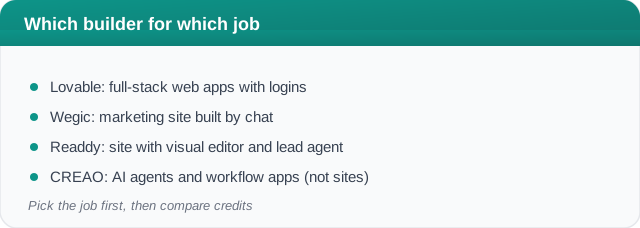
You can start any of these 4 builders free, but they build 3 different things. Lovable builds full-stack apps. Wegic builds simple websites by chat. Readdy builds websites with a visual editor, hosting and a lead-capture agent. CREAO builds AI agents and workflows, not websites. Choose by the job, then compare credit limits.
The short answer: four tools, three different jobs
All four tools sell a similar promise. You describe what you want in plain language and the AI builds it. The output is very different.
Use this table to find your job first. Prices are monthly list prices checked on 9 October 2026, and some are ranges because sources disagree.
| Tool | Builds | Free plan | Entry paid plan |
|---|---|---|---|
| Lovable | Full-stack web apps | 5 daily credits, 30 a month | Pro $25, 100 credits |
| Wegic | Websites built by chat | Starter credits, $2.99 trial | About $10 to $40, sources differ |
| Readdy | Websites with editor and lead agent | 250 credits a month, 2 projects | Starter $25 ($15 on yearly billing) |
| CREAO | AI agents and workflow apps | 30 credits a month, no card | Pro $20 to $25, 250 credits |
How this was researched
AI Nexus did not run hands-on builds with these tools for this guide. Lovable and Readdy figures come from their own pricing pages and documentation where readable. Wegic and CREAO figures come from dated third-party listings, and they conflict, so ranges are shown. The Alf Website Studio figures come from our Alf review, which was checked against Spaceship's own product page and knowledge base.
What each tool actually builds
Lovable: full-stack apps with a database and logins
Lovable turns a prompt into a web app. Our vibe coding comparison describes it as a React front end with a Supabase back end, deployed to a live address. Read our Lovable review for the longer view.
Want to try Spaceship?
Try Spaceship →The free plan gives 5 build credits a day, capped at 30 a month. Pro is $25 a month for 100 monthly credits, and Business is $50 for the same credit count with team features. Top-up credits are priced extra.
Lovable's pricing page says unused monthly plan credits expire two months after they are issued. Choose it when your project needs user accounts or stored data, not just pages.
Wegic: the fastest route to a simple site by chat
Wegic builds a website through conversation. You describe the business, answer follow-up questions, and edit by chat. Our Wegic review covers it in more detail.
Its one-time $2.99 trial is the cheapest way to see a full generated site. Paid plans are credit-based, and credits do not roll over between months. Reviewers also report that failed edits can still use credits.
Published entry-tier prices range from about $10 to $40 a month depending on the source and billing cycle. Wegic has restructured pricing more than once, so read its live page.
Readdy: a site builder with an editor and a lead agent
Readdy generates sites from text, templates, screenshots or URLs, then lets you refine them in a visual editor. Its Readdy Agent captures leads through chat and voice. Plans include forms and hosting.
The free plan gives 250 credits a month and 2 projects. Readdy's documentation lists Starter at $25 a month for 2,500 credits and Pro at $40 a month for 6,000 credits. Its pricing page shows lower effective prices on yearly billing, $15 for Starter and $24 for Pro.
The yearly Starter listing includes a free custom domain for a year, removal of Readdy branding and code download. Confirm each item on the live pricing page.
CREAO: the odd one out, for agents and automations
CREAO is not a website builder. You describe a task, it runs the work in a sandbox, and you can save a good result as a reusable agent. See the CREAO review for the details.
The free plan lists 30 credits a month with no card. Pro is listed at $20 or $25 a month depending on the source, with 250 credits at the higher figure. The review base is small, so test it on low-risk tasks first.
Also worth knowing: Alf Website Studio, with hosting bundled
Alf Website Studio is Spaceship's chat-based site builder, and it sits closest to Wegic. You brief Alf the way you would brief a web developer, it drafts the copy, branding and images, and you refine by chat or in a visual editor. Our Alf review has the detail.
Spaceship lists a 30-day free trial and then $5 a month, with hosting, domain connection and an SSL certificate handled automatically. The trade-offs are no code export, selling limited to Stripe payment links (added May 2026), and a requirement to use Spaceship nameservers if your domain is registered elsewhere. See Wegic vs Alf Website Studio for the lock-in comparison.
What the free plans give you
Found this useful?
Share it with someone deciding between AI tools, or get new comparisons like this in your inbox.
Free plans are enough to judge the workflow. They are rarely enough to ship a finished project.
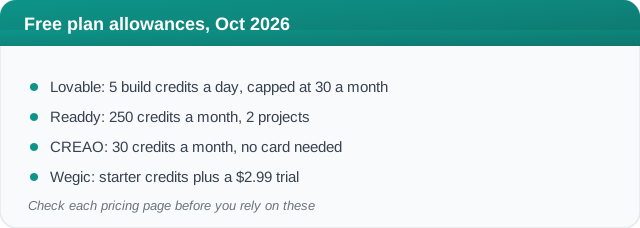
Lovable's 30 credits a month is the tightest ceiling. Readdy's 250 credits and 2 projects is the most generous on paper, but credit costs per action differ between tools, so the numbers are not directly comparable.
What it costs to put a real site live
A prototype on a free subdomain costs nothing. A public site usually needs a paid plan, a custom domain and a plan that removes the builder's branding.
| Tool | Custom domain | Branding removed |
|---|---|---|
| Lovable | Paid plans | Paid plans |
| Wegic | Higher tier | Paid plans |
| Readdy | Starter and above | Starter and above |
| CREAO | Not its main use | Not its main use |
The domain itself is often a separate cost. Our domain renewal price comparison shows what a .com costs over five years, and the launch guide covers hosting and HTTPS.
Credits: the cost that surprises people
All four tools meter usage in credits. A long chat of small edits can use more credits than one clear brief.
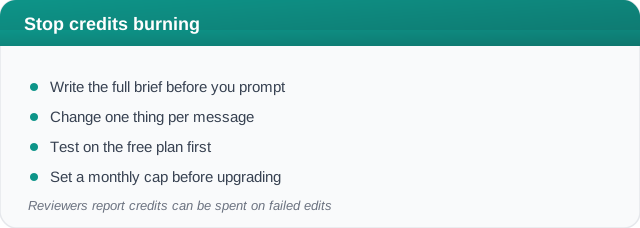
Wegic reviewers report that failed edits can still consume credits, and Wegic credits do not roll over. Lovable credits expire after two months. Readdy credits refresh monthly on monthly plans and once a year on multi-year plans.
Write the whole brief first, change one thing per message, and set a monthly spending cap before you upgrade.
Match the Builder to the Project Risk
The cheapest plan is not automatically the lowest-risk choice. A public brochure site can tolerate a short trial and a few manual edits. An app with logins or stored data needs a builder that supports the underlying product requirements, plus a plan for export, ownership, and ongoing maintenance.
- Marketing site: compare Wegic and Readdy on editing, domain support, forms, and branding removal.
- Full-stack prototype: use Lovable's app-oriented workflow when the brief needs accounts, a database, or application logic.
- Repeatable internal task: use CREAO only when the output is an agent or workflow rather than a public site.
These are fit conclusions from the documented product scope, not a performance benchmark. The article does not claim hands-on build speed, and Wegic and CREAO prices remain ranges because the cited public sources disagree.
For a first decision, write down the non-negotiable requirement before opening a builder. If it is authentication or stored data, start with the app-oriented option. If it is a public site, compare editor access, custom-domain support, branding, and lead capture. If it is a repeatable internal task, compare agent controls and the cost of each run. This keeps the comparison tied to the project instead of to a headline credit number.
Also record the exit path before you start: where the domain will live, whether the plan includes hosting, and whether the builder offers code download or an export route. Those details determine the cost of changing tools later, especially when the first version becomes a real customer-facing project.
Which one should you choose?
- Choose Lovable if your project needs user accounts, stored data or app logic, not only pages.
- Choose Wegic if you want a simple business site drafted by chat with no editor to learn.
- Choose Readdy if you want a site with a visual editor, forms and a chat or voice lead-capture agent.
- Choose Alf Website Studio if you already use Spaceship for domains and want hosting, domain connection and SSL bundled into one $5 a month plan.
- Choose CREAO if the goal is an agent or a repeatable workflow, not a public website.
- Choose a traditional builder if you need a full online store. See our AI website builder roundup.
A low-cost way to test them
- Write one brief: a business name, three pages and one call to action.
- Run it on Readdy's free plan and on Wegic's $2.99 trial to compare two site drafts.
- Try Lovable's free daily credits only if the brief needs logins or a database.
- Use CREAO's free plan for a separate task, such as a weekly summary.
- Compare the output, the editing experience and how many credits each draft used.
After the build: domain, hosting and HTTPS
A finished draft is not a launched site. You still need a domain, a connection to the builder, and HTTPS. Many builders include hosting and a certificate on paid plans, so check before you buy them twice.
Start with How to Launch an AI-Built Website, then compare registrars in Domain Renewal Prices Compared. If you are weighing coding tools instead, read Claude Code Alternatives.
Our verdict: start with Wegic.
Try Wegic →How we researched “Lovable vs Wegic vs Readdy vs CREAO 2026”: every figure comes from official vendor documentation, published pricing pages and public review sites, not from hands-on lab testing (see our editorial methodology).
Frequently Asked Questions
Which is best for a small business website: Lovable, Wegic or Readdy?
Wegic and Readdy are built for websites, so they are the closer fit. Readdy adds a visual editor, hosting, forms and a lead-capture agent. Wegic is chat-only and fast for a simple site. Lovable is stronger when the site needs logins or a database.
Is CREAO a website builder?
No. CREAO builds AI agents and workflow apps from a plain-language description. It is included here because people searching for AI builders often meet it next to the other three. If you need a public website, choose Wegic or Readdy instead.
Which of these has the best free plan?
It depends on the job. Lovable gives 5 build credits a day, capped at 30 a month. Readdy gives 250 credits a month and 2 projects. CREAO gives 30 credits a month with no card. Wegic offers starter credits and a $2.99 trial. Compare on your own brief.
How much does Lovable cost?
Lovable is free to start, with a Pro plan at $25 a month for 100 monthly credits and a Business plan at $50 a month, according to its pricing page and recent summaries. Paid tiers scale up with more credits. Top-up credits cost extra, so check the page before you buy.
Why do Wegic prices look different on different sites?
Wegic has changed its plans several times, and listings disagree. Published entry-tier figures range from about $10 to $40 a month depending on the source and billing cycle. Read the live pricing page and check whether the price shown is monthly or yearly.
Can I use my own domain with these builders?
Usually on a paid plan. Lovable lists custom domains on paid plans, and Readdy lists publishing with a custom domain on Starter. Wegic lists a custom domain on its higher tier. Confirm the exact plan, then see our domain guide for registrar renewal prices.
Do unused credits roll over?
Not always. Lovable says unused monthly plan credits expire two months after they are issued. Wegic credits do not roll over between months according to reviews. Readdy credits refresh each month on monthly plans. Check the rules before you buy a larger bundle.
Can I export the code from these builders?
Sometimes. Lovable supports GitHub export according to our vibe coding guide, and Readdy lists code download on its Starter plan. Wegic reviews describe code export that can use credits. Check the export rules before you build anything you cannot afford to lose.
Where does Alf Website Studio fit next to these four?
Alf Website Studio is Spaceship's chat-based site builder and sits closest to Wegic. It lists a 30-day free trial and $5 a month with hosting, domain connection and SSL included. It has no code export, and selling is limited to Stripe payment links, so it suits people who already use Spaceship for their domain.