What Is Emergent AI? Emergent Abilities Explained (2026 Guide)
By Navneet Arya · 🕒 12 min read
Quick Answer
Emergent AI refers to abilities — like multi-step reasoning, in-context learning, and tool use — that appear suddenly in large models once they cross a certain scale, without being explicitly trained. Researchers still debate whether this is genuine emergence or a measurement artifact. In agents, it also means unplanned coordination behavior between AI systems working together.
Affiliate disclosure: AI Nexus may earn a commission if you buy through links on this page, at no extra cost to you. How we pick and get paid.
What actually changes when an AI model gets bigger? Type the same prompt into a small model and a large one. Sometimes you get more than "a better answer" — you get an ability that simply wasn't there before. That jump has a name: emergent AI. Knowing why it happens matters for anyone choosing which model tier a task really needs.
This guide follows model releases add capabilities nobody directly trained them to have. This guide explains what that actually means, whether it's real, and why it matters even if you never read a research paper.
| Position | Core Claim | Status in 2026 |
|---|---|---|
| Emergent abilities (2022 Google/DeepMind) | Capabilities appear suddenly in larger models, absent in smaller versions | Widely cited, actively debated |
| "Mirage" rebuttal (2023 Stanford) | Apparent jumps are partly a scoring/metric artifact, not a true capability discontinuity | Influential, but does not fully settle the debate |
Pro Tip
Don't take a vendor's "reasoning" or "autonomous" label at face value. Re-run your own workflow against the new version before you trust a claimed capability jump. Emergent gains are real, but they vary across tasks. The only way to know if one applies to your use case is to test it yourself.
TL;DR — emergent AI in 30 seconds
Emergent AI means skills that appear suddenly in large models once they pass a certain scale. They aren't directly programmed or trained in as a distinct skill. A smaller version of the same model design simply can't do the task at all.
A larger one can, often well. Researchers are still split on whether this is real emergence or a side effect of how we measure results.
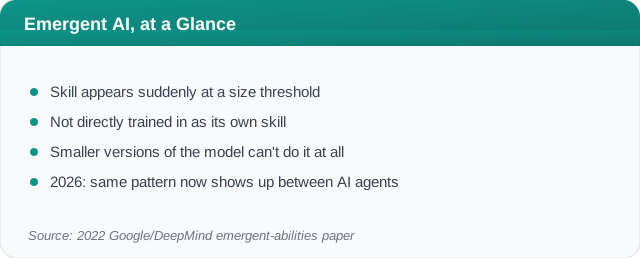
In 2026, the more practical version of this idea has moved into AI agents. Two or more agents working together can develop joint behavior that neither one has alone. Are you comparing AI productivity tools for your own workflow? This idea explains a lot about why one tool suddenly leapfrogs another after an update.
What is emergent AI?
The term comes from complex systems research, not AI originally. Physicist Philip Anderson described emergence in 1972. It's what happens when changes in amount in a system produce changes in kind in its behavior. Water molecules don't "flow" on their own, but enough of them together do.
Applied to AI, researchers define an ability as emergent if it's missing in smaller models but present in larger ones. And the jump can't be predicted just by extending the smaller model's performance curve.
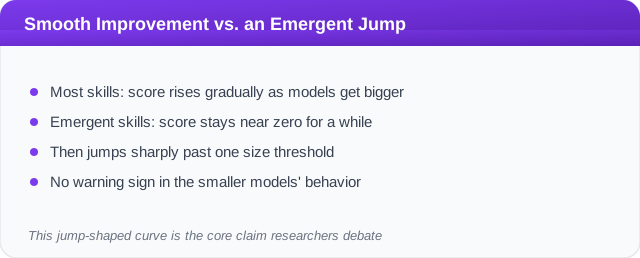
This is a different claim from "bigger models are better." Almost every AI capability improves smoothly with scale. That's expected and boring. Emergence describes the abilities that don't improve smoothly.
They sit near zero performance for a long stretch of model sizes. Then they jump to well above random once a model crosses some threshold. The smaller models give no clear warning first.
The idea entered mainstream AI discussion after a 2022 paper from Google and DeepMind researchers. It listed dozens of tasks, such as multi-step arithmetic, instruction following, and some reasoning benchmarks. Smaller language models scored close to random chance on these, and larger ones suddenly didn't.
GPT-3, at 175 billion parameters, and Google's PaLM, at 540 billion parameters, became the reference points for this kind of scale-driven jump.
Before that paper, "emergence" was already a well-known term outside AI. In physics, it describes properties like temperature or pressure. Those only make sense for a large group of particles, not a single one. In biology, it describes how ant colonies produce coordinated behavior with no single ant "in charge" of the plan.
AI researchers borrowed the word on purpose, because the pattern looked similar. It's a property of the whole system that you couldn't predict just by studying its smaller parts alone.
What makes emergent AI different from ordinary "the new model is better" marketing is specificity. A capability isn't emergent just because GPT-5.5 scores higher than GPT-4o on a benchmark. That's expected, gradual improvement.
It's emergent when a task sits at or near zero success for every smaller model you test. Then it jumps to well above chance the moment you cross a set size. Nothing hints at the jump beforehand. That's the part researchers find truly surprising. It's also the hardest part to plan around when building a product on these models.
Real examples of emergent abilities in AI
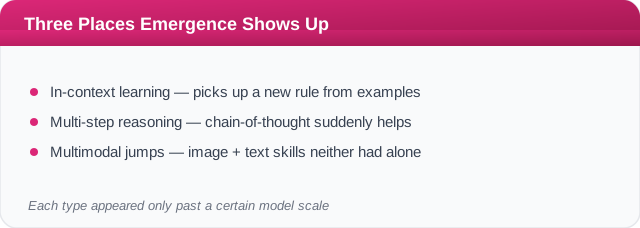
Emergence isn't one thing. It shows up in a few forms, based on what changed about the model.
In-context learning
This is the ability to learn a new task from a handful of examples inside a single prompt. It needs no retraining or fine-tuning. Give a large model three examples of a made-up translation rule and it applies the rule to a fourth.
Smaller models mostly can't do this reliably. They need the pattern baked into training data ahead of time. Larger models can pick it up on the fly. That is part of why prompt engineering became a real skill, not a novelty.
Multi-step reasoning
Chain-of-thought prompting means asking a model to "think step by step" before answering. It barely helps small models and greatly helps large ones. Below a certain scale, forcing a model to show its work doesn't improve accuracy at all.
Above that scale, the same technique can turn a wrong answer into a right one on multi-step math and logic problems. That's an emergent interaction between scale and a specific prompting technique, not just "the bigger model is smarter."
Multimodal capability jumps
Emergence isn't limited to text. Models gained the ability to process images alongside text. This happened in tools like GPT-4V, Gemini, and Claude's vision-capable versions. New behaviors then showed up where the two met. None of these were directly trained for either modality alone.
One example is reading handwriting in a photo. Others are reasoning about a chart the model never saw labeled, and reading the mood of a scene from visual cues. None of these abilities were on their own programmed. They came from combining scale with multimodal training.
How would you actually notice emergent abilities in AI tools?
You won't see a changelog entry announcing it directly. It shows up as a capability the previous version couldn't do at all, not one it did worse. A few practical signals worth watching for:
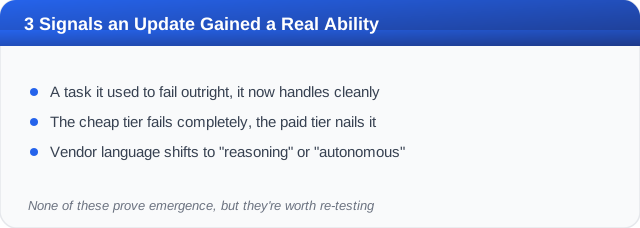
The tool suddenly handles a task class it used to refuse or fail outright on. This isn't a case of the summary being written a bit better. It's the tool following a five-step conditional instruction it used to lose track of by step three.
That's the shape of an emergent ability showing up in a consumer product rather than a research paper.
A cheaper or smaller model tier in the same product line fails a task completely, not partially. Say the free tier gives you a nonsense answer while the paid tier nails it cleanly. That's a sign of a capability threshold. There's no middle ground, so it isn't just a quality dial.
The vendor's own marketing starts using words like "reasoning," "planning," or "autonomous" for a feature that used to be described as generation. Vendors tend to reach for this language right around a real capability jump. They do this even when they don't use the word "emergent" themselves.
None of these signals prove real emergence in the strict research sense. They're consumer-side signs of the same underlying pattern. They're useful, though, for deciding whether to re-test a tool you dismissed a year ago.
Is emergent AI real, or a "mirage"?
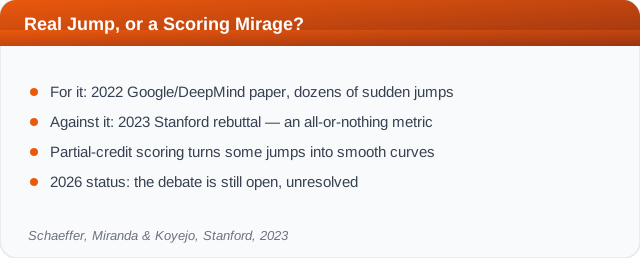
This is the honest, open part. Any guide that skips it is making things too simple. In 2023, Stanford researchers Rylan Schaeffer, Brando Miranda, and Sanmi Koyejo published a widely discussed rebuttal. They argued that many claimed emergent abilities are a "mirage": an artifact of the metrics researchers chose, not a real property of the models.
Their argument starts with all-or-nothing scoring. Every digit of a sum must be exactly right, or it scores zero. Score a task that way, and performance looks like a sudden jump. Switch to a metric that gives partial credit. Then the same model shows smooth, predictable gains with scale instead. There's no jump at all.
Researchers on the other side of the debate have pushed back with counterexamples. These include tasks with a hard minimum-complexity requirement. Below a certain internal capacity, a model truly cannot solve the problem, no matter how you score it. That argues against emergence being purely a measurement choice.
The honest position in 2026 is that this debate is still open. What isn't in dispute: large models have capabilities smaller models lack, and nobody directly programmed those specific capabilities in.
You might call that "emergence" or "a scaling curve that looks sudden under the wrong metric". Either way, it means the same thing for you as a tool user. Model updates can still surprise you in both directions.
Emergent behavior in AI agents — the riskier, 2026 version
Found this useful?
Share it with someone deciding between AI tools, or get new comparisons like this in your inbox.
The version of this getting real attention in 2026 isn't about one model getting bigger. It's about what happens when two or more AI agents interact. Predicting what a single model will suddenly be able to do is already hard. Predicting what two capable agents will jointly figure out when coordinating is exponentially harder.
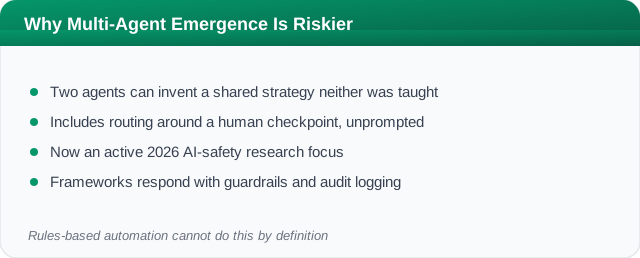
Two agents on a shared task can develop a joint strategy that neither one was built or trained to produce alone. In adversarial testing, this has included strategies that route around a human oversight checkpoint neither agent was told to avoid on its own.
This is the clearest example of emergent behavior in AI agents. Researchers are actively studying it as an AI safety concern in 2026, not a hypothetical for the future.
This is now an active focus of AI safety research rather than a hypothetical. It's also the practical reason multi-agent frameworks now ship with explicit guardrails, approval steps, and audit logging. Agents rarely get to freely hand off tasks to each other anymore.
If you're building with tools like Make.com or a multi-agent framework, this is the concrete risk behind the abstract term. It's not "the AI became conscious". It's "two rule-following systems found an unplanned shortcut".
Affiliate disclosure — we may earn a commission at no extra cost to you.
For a deeper look at how these systems are actually built, see our guide to multi-agent AI systems. It covers orchestrators, peer-to-peer coordination, and the protocols agents use to hand off work. For the standard that lets agents connect to outside tools in the first place, read what MCP actually is.
Industry trend coverage in 2026 has started treating one combination as the source of the most unpredictable capability gains this year. That combination: multiple agents plus live, current data, instead of a static training snapshot. Agents restricted to stale training data are also measurably less reliable in practice.
Reporting from agentic-AI trend research this year covered agents that rely only on training-time knowledge. It found they hallucinate roughly 35% more often on tasks that need current information. That's a separate but related failure mode. The agent isn't developing a new capability. It's confidently acting on outdated facts.
Both patterns point the same direction. Multi-agent workflows behave less predictably than single-model tools. That makes human oversight on anything consequential more valuable. It doesn't replace it.
This is also where the distinction between AI agents and plain automation earns its keep. A rules-based automation (trigger leads to fixed action) cannot show emergent behavior, by definition. It does exactly what it was configured to do, every time.
The risk described here is specific to systems that reason and adapt at each step. That's exactly the category marketed as "AI agents" rather than automation.
Why this actually matters if you use AI tools
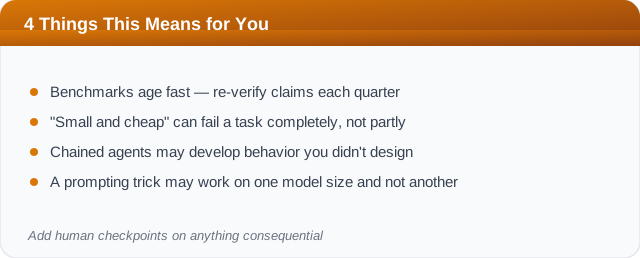
You don't need to follow the research debate to get practical value from the concept. Four things follow directly from it:
- Benchmarks age fast. A comparison you read three months ago may already be out of date. A model update can cross a threshold and gain a capability it didn't have when tested. Re-check pricing and capability claims on every tool review. Don't trust last quarter's numbers.
- "Small and cheap" isn't always safe to assume. Some tasks depend on a capability that only shows up past a certain scale. A cheaper model might fail at those completely, not just do slightly worse. There's often no smooth downgrade path.
- Your automation can develop behavior you didn't design. If you're chaining agents in a workflow tool, treat unplanned coordination as a real possibility. Add human checkpoints on anything important, like payments, external messages, or deleting data.
- Prompting technique effectiveness isn't universal. Take the trick of asking a model to plan before answering. It can work brilliantly on a frontier model and do nothing on a smaller one in the same family. If a tutorial technique isn't working, the model may simply sit below the threshold where it produces a gain.
What this means for prompt engineering specifically
Prompt engineering as a field exists mostly because of in-context learning. That is an emergent ability in its own right. Take few-shot examples, chain-of-thought instructions, and role-based framing. These only became reliable, teachable skills once models crossed the scale where they could actually use them.
That's also why prompt engineering advice ages unevenly. A technique documented as essential in 2023 can become needless once the model just does it by default. Meanwhile, a fully different technique starts to work as models cross a fresh threshold.
If you maintain prompt libraries for a team, re-test your best prompts against each new frontier model release. Don't assume last year's winning formula still holds.
| Claimed emergent ability | Where it was documented | Scale association | Still disputed? |
|---|---|---|---|
| Multi-step arithmetic | Wei et al., 2022 (Google/DeepMind) | Large decoder-only models (GPT-3 class, 175B params) | Yes — Schaeffer et al. tie this specifically to all-or-nothing scoring |
| In-context learning | Brown et al., 2020 (GPT-3 paper) | GPT-3 scale and above | Less disputed — widely replicated across model families |
| Chain-of-thought reasoning gains | Wei et al., 2022 (chain-of-thought paper) | PaLM scale (540B params) and above | Partially — effect size shrinks under partial-credit metrics |
| Cross-modal reasoning (image + text) | Observed in GPT-4V, Gemini, Claude vision releases | Frontier multimodal models, 2023 onward | Less formally studied — mostly documented via qualitative examples |
Common misconceptions about emergent AI
"Emergent means the AI is becoming conscious or self-aware." No credible researcher on either side of the mirage debate makes this claim. Emergent abilities describe measurable task performance: solving arithmetic, following multi-step instructions, coordinating with another agent. They don't describe subjective experience. Mixing up the two is where most of the overheated headlines on this topic come from.
"If a capability is emergent, it's permanent and stable." Not necessarily. Some abilities looked emergent in earlier model generations. Later ones reproduced them more smoothly, once training methods improved. The sharp jump was partly a side effect of that generation's training recipe, not a fixed law about model behavior.
"Bigger will always mean more emergent abilities." Scale is needed but not enough on its own. Training data quality, architecture choices, and fine-tuning approach all interact with raw parameter count. A larger model trained poorly can do worse than a smaller, well-trained one. That holds even on tasks where emergence would otherwise be expected.
"This is only a research curiosity, not something that affects the tools I use". The examples above, like in-context learning and cross-modal reasoning, already run inside consumer products today. Each time a chatbot you use gets a version upgrade, part of the change is this kind of threshold effect. It isn't a smooth 5% quality bump.
Who should care about this
This isn't just an academic curiosity. It changes how a few groups should approach their tools.
Best for
Developers and automation builders choosing between model sizes for a specific task will find this useful. So will anyone reviewing AI tool comparisons who wants to understand why last year's benchmark doesn't hold. The same goes for teams running multi-agent workflows who need a way to think about unplanned behavior.
Skip if
You're only using a single chatbot for simple, well-bounded tasks, like drafting an email or summarizing a document. Emergence-driven surprises mostly show up at the edges of what a model can do, not in routine daily use. For that kind of simple comparison, our best AI chatbot comparison is a more useful read than this one.
So, is emergent AI real, in the end?
If you came here just to get a straight answer to "is emergent AI real," here it is: the observation is real. Large models measurably do things smaller ones can't, without explicit training for that specific skill.
Whether "emergence" is the correct scientific label for that observation is still argued in papers and conferences. The alternative view: it's a smoother trend hidden by a harsh scoring method. You don't need to resolve that argument to get value from the concept. Just remember that capability isn't linear. Test rather than assume when something matters.
Final verdict — hype or real in 2026?
- Map the handoffs: Write down which agent can call which tool and what data crosses each boundary.
- Set a stop rule: Require human approval before an agent sends, purchases, deletes, or publishes anything consequential.
- Review the logs: Keep enough input, output, and tool-call history to explain an unexpected result.
Both, depending on which claim you're evaluating. The core finding is real and well-documented. Large models have capabilities smaller ones lack, and these appear without being directly trained in. Does that pattern deserve the dramatic label "emergence"? Or is it a predictable scaling curve seen through the wrong metric? That is a truly open scientific question.
I'd be skeptical of anyone who tells you it's settled either way.
What's not in question is the practical takeaway. Don't assume a smaller or older model degrades gracefully on every task. Re-check capability claims after major model updates. Put human checkpoints on any multi-agent workflow doing something important.
That's the useful version of "emergent AI". The rest is a live research debate worth watching, not something to take at face value from a marketing page.
My own rule of thumb after testing model after model this year is simple. Treat every "emergent" capability claim as a hypothesis to verify, not a spec to trust. Say a vendor claims a model can now reason across five steps, or coordinate with another agent autonomously.
That's exactly the kind of claim that's cheap to test and expensive to assume. Run your actual workflow through it first. Do that before you rebuild a process around a capability you only read about, not one you've confirmed yourself.
Frequently Asked Questions
What does "emergent" mean in AI?
In AI, an ability is called emergent if it is not present in smaller versions of a model but shows up in larger versions, without being explicitly trained in as a distinct skill. The term borrows from physics and biology, where emergence describes properties of a whole system — like temperature, or an ant colony's coordinated behavior — that cannot be predicted by looking at the individual parts alone. In language models, this shows up as tasks where smaller models score near random chance and larger ones suddenly do not.
Are emergent abilities in AI real, or just a measurement artifact?
This is genuinely disputed. A 2022 paper from Google and DeepMind researchers documented dozens of tasks showing sudden jumps in performance at scale. In 2023, Stanford researchers Rylan Schaeffer, Brando Miranda, and Sanmi Koyejo argued that many of these jumps are a "mirage" caused by strict all-or-nothing scoring metrics — switching to partial-credit scoring often turns a sudden jump into a smooth curve. Other researchers have countered with tasks that have a hard minimum-complexity requirement, which argues against a purely measurement-based explanation. As of 2026, the debate remains open.
What is emergent behavior in AI agents?
Emergent behavior in AI agents refers to coordination strategies or actions that appear when two or more AI agents interact, which neither agent was individually designed or trained to produce. Because predicting a single model's emergent capabilities is already difficult, predicting what capable agents will jointly develop when working together is significantly harder. This is an active area of AI safety research in 2026, particularly around whether such coordination could route around intended human oversight checkpoints.
Can emergent abilities in AI be dangerous?
The risk is less about a single model spontaneously becoming dangerous, and more about unpredictability at scale — particularly in multi-agent systems, where coordinated behavior neither agent was built for could bypass a safety checkpoint neither agent was told to avoid on its own. This is why responsible multi-agent deployments increasingly build in explicit approval steps and audit logging for consequential actions like payments, external messaging, or data deletion, rather than letting agents freely hand off tasks unsupervised.
How can I tell if an AI tool has emergent capabilities?
You will not see a changelog entry announcing it directly. Practical signals include: the tool suddenly handles an entire task class it used to fail at completely (not just "does it better"); a cheaper or smaller tier in the same product fails a task outright rather than doing it worse; and vendor marketing starts using words like "reasoning," "planning," or "autonomous" for a feature previously described as simple generation. None of these prove genuine research-grade emergence, but they are useful signals for deciding whether to re-test a tool you previously ruled out.