Best AI Writing Tools 2026 — Reviewed, Ranked & Compared
By Navneet Arya · 🕒 10 min read
Quick Answer
The best AI writing tool in 2026 depends on your goal: Grammarly (free) for editing and improving existing text; Rytr ($9/mo) for generating drafts fast; QuillBot (free) for paraphrasing; Writesonic ($16/mo) for SEO blog posts; Frase ($15/mo) for SEO research + writing; Jasper ($59/mo billed annually) for brand-consistent team content. This guide compares all 6 on price, free plans, and output quality.
Prices in USD are vendor list prices as of September 2026 (annual billing where noted).
Grammarly is the best AI writing tool overall, with a free plan for improving your own writing. Rytr ($9/month) is best for fast first drafts. QuillBot has the strongest free plan for paraphrasing.
Writesonic ($16/month) wins for long-form SEO blog posts, Frase ($15/month) for keyword research, and Jasper ($59/month billed annually ($69 monthly)) for brand-consistent team content. There is no single best tool — the right pick depends on your bottleneck: quality, speed, rewriting, or SEO.
The guide maps each tool to a specific writing bottleneck rather than ranking them on one scale. "Best AI writing tool" is really six different questions wearing one headline — once you know whether your problem is speed, quality, rewriting, or SEO, the right pick stops being a debate.
What Are the Best AI Writing Tools in 2026?
The best AI writing tools in 2026 solve four different problems. Grammarly improves writing you've already done. Rytr generates first drafts fast, at $9/month. Jasper adds brand voice and team collaboration for marketing departments, and Sudowrite is built specifically for long-form fiction.
QuillBot paraphrases and summarises on a free plan, and Writesonic handles long-form SEO blog posts. The right pick depends on whether you need to generate, improve, rewrite, or optimise content.
The AI writing tool market has six truly different product categories, but most roundups treat them as interchangeable and rank them by marketing budget. They are not interchangeable.
Using a grammar checker when you need a content generator wastes money. Using a long-form SEO tool when you need quick social captions is overkill.
Every tool in this guide has been independently researched across its real primary use case. The verdict for each tool is based on what it actually does well, not which affiliate commission is highest.
How to Pick in 3 Steps
- Name your bottleneck. Writing quality points to Grammarly. Writing speed points to Rytr or Writesonic. Rewriting existing content points to QuillBot.
- Check whether SEO matters. If every post needs to rank, Frase's built-in competitor research earns its price over a general-purpose generator.
- Confirm you're solo or a team. Solo writers rarely need Jasper's brand-voice and collaboration features — save the $59/month billed annually ($69 monthly) unless multiple writers share one brand voice.
Quick Comparison: Best AI Writing Tools 2026
| Tool | Best For | Free Plan | Paid From | Rating |
|---|---|---|---|---|
| Grammarly ⭐ Top Pick | Improving your own writing | ✅ Unlimited | $12/mo | ⭐ 4.5 |
| Rytr | Fast first-draft generation | ✅ 10K chars/mo | $9/mo | ⭐ 4.0 |
| QuillBot | Paraphrasing & summarising | ✅ 125 words/pass | $9.95/mo | ⭐ 4.3 |
| Writesonic | Long-form SEO blog posts | ✅ 1 article/mo | $16/mo | ⭐ 4.2 |
| Frase | SEO research + content briefs | ❌ $1 trial | $15/mo | ⭐ 4.2 |
| Jasper | Brand voice & team content | ❌ 7-day trial | $39/mo | ⭐ 4.3 |
#1 Grammarly: Best AI Writing Tool for Improving Your Own Writing
Rating: 4.5/5 · Free plan: Unlimited grammar checks · Paid: $12/month
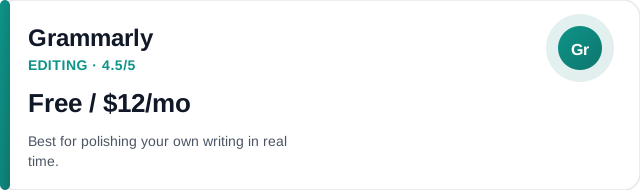
Grammarly is the most widely used AI writing tool in the world, and for good reason. It runs as a browser extension, a desktop app, and inside Google Docs, integrating with 500+ apps so it works wherever you write.
The free plan checks grammar, spelling, and punctuation with no word limit. The paid Premium plan ($12/month) adds real-time tone checks, full-sentence rewrites, a clarity score, and word choice tips.
What Grammarly does better than any other tool: it works in context. When you're writing a difficult client email, Grammarly's tone detector flags blunt or passive phrasing in real time, before you hit send.
When you're editing a long report, the Clarity score pinpoints the exact sentences that are too dense to read easily. No other tool provides this level of real-time, in-context feedback across every writing surface you use.
Where Grammarly falls short: It corrects; it doesn't create. If your bottleneck is generating content from scratch rather than polishing what you've already written, Grammarly alone won't solve it. Pair it with Rytr or Writesonic for a complete writing workflow: Grammarly handles the output quality, the other tool handles the input speed.
Who it's for: Everyone who writes professionally. Journalists, marketers, freelancers, students, and business owners all benefit from the free plan if they send emails, write reports, or produce content. Upgrade to Premium when you find yourself regularly wanting tone detection or full-sentence rewrites.
→ Full Grammarly review · → Best Grammarly alternatives, for when the price or style doesn't fit
Ad disclosure — we may earn a fee at no extra cost to you.
#2 Rytr: Best Budget AI Writing Tool for Fast First Drafts
Rating: 4.0/5 · Free plan: 10,000 characters/month · Paid: $9/month

Rytr is the most good-value AI content generator available in 2026. The $9/month Saver plan gives you unlimited characters and 40+ use-case templates covering blog intros, product descriptions, email sequences, social captions, ad copy, and more.
For freelancers and content creators who need to produce structured short-form content quickly, Rytr removes the blank-page problem without needing big investment.
How the workflow works in practice: select a use case (e.g. "Blog Section Writing"), enter your topic and 2–3 key points, choose your tone (professional, casual, enthusiastic), and Rytr generates 2–3 variations in under 10 seconds.
Pick the best one, edit it with your own voice, and move on. This workflow reduces first-draft time on any piece under 800 words by roughly 60%.
Honest limitation: Rytr is optimised for 200–600 word outputs. It does not have a dedicated long-form blog post generator that competes with Writesonic's Article Writer.
If you need full 1,500–2,500 word SEO articles generated in one workflow, Writesonic or Jasper is the better investment. Rytr is the right tool for high-volume short-form content: social batches, email sequences, and product copy. It's not built for weekly long-form blog publishing.
→ Full Rytr review · → Rytr vs Writesonic: which AI writer wins in 2026?
Ad disclosure — we may earn a fee at no extra cost to you.
#3 QuillBot: Best AI Writing Tool for Paraphrasing and Rewriting
Found this useful?
Share it with someone deciding between AI tools, or get new comparisons like this in your inbox.
Rating: 4.3/5 · Free plan: 125 words per paraphrase pass · Paid: $9.95/month
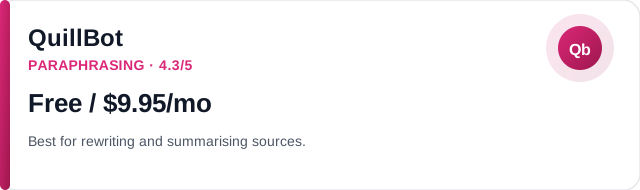
QuillBot occupies a unique position: it doesn't generate original content, it improves existing content. The paraphrasing tool rewrites any text in 7 modes: Standard, Fluency, Formal, Simple, Creative, Expand, and Shorten.
That range makes it the most versatile rewriting tool in this category. The Summariser condenses long documents into clean abstracts. The Citation Generator handles APA, MLA, Chicago, and Harvard formatting on its own.
Where QuillBot outperforms everything else: Academic and research-heavy writing. QuillBot's free plan covers all three tasks students need most: paraphrasing sources without changing their meaning, summarising 40-page research papers in minutes, and generating citations on its own. No other tool in this price range matches this combination of academic writing utilities.
The Fluency mode exactly is the most useful for non-native English writers. It rewrites your text to sound natural in standard English while preserving your original meaning. That's more useful than grammar correction for writers who have the ideas but struggle with idiomatic phrasing.
Free plan reality: 125 words per paraphrase pass is the main limitation. For longer documents, you paste and paraphrase section by section. The paid plan ($9.95/month) removes this limit, adds all 7 paraphrase modes (free only has 2), and includes the Plagiarism Checker.
→ Full QuillBot review · → Grammarly vs QuillBot: which tool do you actually need?
Ad disclosure — we may earn a fee at no extra cost to you.
#4 Writesonic: Best AI Tool for Long-Form SEO Blog Posts
Rating: 4.2/5 · Free plan: 1 article/month · Paid: $16/month
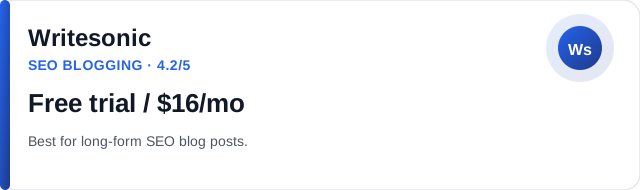
Writesonic is the strongest AI writing tool for solo bloggers and content marketers who need to produce complete, structured long-form posts at scale. Article Writer 6.0 takes a single keyword, analyses competing content, and generates a 1,500–2,500 word draft.
That draft includes H2 structure, an intro, SEO-friendly subheadings, and a conclusion. For writers publishing 4+ articles per month, this compresses the most time-consuming part of the publishing process a lot.
The Chatsonic chatbot (included in all paid plans) adds real-time web access. You can research, fact-check, and expand your article within the same tool, without switching to a browser. This alone makes Writesonic more useful for content that requires current information than general-purpose AI tools trained on older data.
Writesonic vs Jasper: the $16/month Individual plan at Writesonic gives unlimited words and Article Writer access. Jasper's Creator plan at $59/month billed annually ($69 monthly) adds brand voice rules and shared documents.
For a solo blogger with no team, the $23/month price difference doesn't buy you meaningfully better content. It buys you features you don't need yet. Upgrade to Jasper when you're managing a team or working with brand-sensitive client accounts.
→ Jasper alternatives: Writesonic, Rytr, and Copy.ai compared for solo creators
Ad disclosure — we may earn a fee at no extra cost to you.
#5 Frase: Best AI Writing Tool for SEO Content Research
Rating: 4.2/5 · Free plan: $1 trial (5 days) · Paid: $15/month
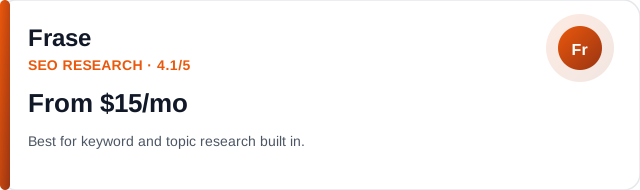
Frase is the only tool on this list that combines SEO research and AI writing in a single workflow. Before you write a word, Frase analyses the top 20 Google search results for your target keyword.
It shows you the topics, headers, and questions your competitors cover, and scores how thoroughly your draft covers them. The AI writer then generates content informed by that competitive research.
This matters because most AI writing tools generate content in a vacuum. They don't know what's ranking for your keyword or what gaps you could fill to outrank existing pages. Frase's research layer turns AI writing from content generation into content strategy.
The honest trade-off: Frase's AI generative output is weaker than Writesonic's for pure long-form drafts. It is stronger for content briefs, outlines, and question-targeting: the SEO research workflow is among the strongest in this list. Many content teams use both: Frase for the brief and research, Writesonic or Jasper for the draft.
Who should use Frase: Content marketers and SEO writers who publish at least 4–8 posts per month. It's the right fit if you need every post optimised for a specific target keyword. The $15/month Solo plan (4 documents/month) is tight, so consider the Basic plan at $45/month if you publish weekly.
Ad disclosure — we may earn a fee at no extra cost to you.
#6 Jasper: Best AI Writing Tool for Marketing Teams
Rating: 4.3/5 · Free plan: 7-day trial · Paid: $39/month
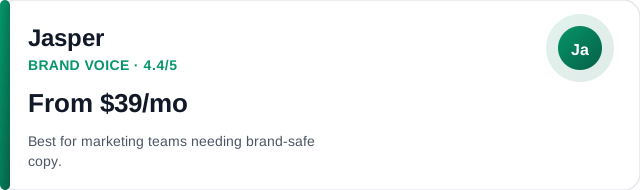
Jasper is the top-tier AI writing tool built for marketing teams rather than solo creators. Its Brand Voice feature is the standout capability.
Paste examples of your best existing content, and Jasper learns your tone, word choice, and style, then applies it on its own to every output. For agencies and content teams managing multiple writers producing content for one brand, this consistency is the primary value.
The honest assessment for individuals: at $59/month billed annually ($69 monthly), Jasper is 2–4x more expensive than Writesonic, Rytr, and QuillBot. For solo writers, the output quality difference does not justify the price premium.
Writesonic at $16/month produces equivalent long-form blog post quality for the majority of content workflows. Jasper earns its price tag at the team level: the team features, permission controls, and multi-writer brand voice rules are what you pay for.
→ Full Jasper review: pricing tiers, Brand Voice, and who it's actually worth it for · → Jasper alternatives, cheaper options ranked
Ad disclosure — we may earn a fee at no extra cost to you.
Which AI Writing Tool Should You Choose?
The right answer maps directly to your primary pain point:
- Your writing needs to sound more professional → Grammarly (free plan covers most needs)
- You spend too long writing first drafts → Rytr ($9/month, best value for short-to-medium content)
- You need to paraphrase research or summarise long documents → QuillBot (free plan functional for students)
- You publish SEO blog posts weekly → Writesonic ($16/month, strongest long-form AI for solo creators)
- You need every post to rank and you want competitor research built in → Frase ($15/month, pair it with Writesonic for research + drafting)
- You manage a content team and need brand voice consistency → Jasper ($59/month billed annually ($69 monthly), justified at team scale)
The Recommended Stack for Most Writers in 2026
If you want a handy, cost-efficient setup that covers the full writing workflow:
- Grammarly free: always-on quality layer across every app
- Rytr $9/month: fast drafts for short-form content and structured copy
- QuillBot free: paraphrasing and summarising as needed
This three-tool stack costs $9/month and handles 90% of most solo writing workflows. Add Writesonic ($16/month) when you start publishing long-form blog content regularly. Upgrade to Jasper only when you have a team to justify it.
See also: → Best AI writing tools for beginners, if you're new to AI writing tools and want a simpler entry point. And if you're exactly hunting for Grammarly replacements: → Best Grammarly alternatives in 2026, tested and ranked.
How we researched “Best AI Writing Tools 2026”: every figure comes from official vendor documentation, published pricing pages and public review sites, not from hands-on lab testing (see our editorial methodology).
Frequently Asked Questions
What is the best AI writing tool in 2026?
The best AI writing tool depends on your use case. For improving your own writing: Grammarly (free plan covers most needs). For generating first drafts: Rytr ($9/month) or Writesonic ($16/month). For paraphrasing and rewriting: QuillBot (free plan available). For SEO content with research: Frase ($15/month). For brand-consistent team content: Jasper ($59/month billed annually). There is no single best tool — the right answer is whichever one solves your specific bottleneck.
Which AI writing tool has the best free plan?
Grammarly has the most useful free plan — unlimited grammar and spelling checks across every app you use, with no word limit. QuillBot's free plan is second-best for students who need paraphrasing (up to 125 words per pass) and summarising. Rytr offers 10,000 free characters per month for content generation. All three free plans are genuinely functional for regular use — not just trials.
Is Jasper better than ChatGPT for writing?
Jasper is better than ChatGPT for marketing teams that need brand voice consistency across multiple writers — it remembers your tone, vocabulary, and style. ChatGPT is better for individuals who want general-purpose writing help at a lower cost ($20/month for ChatGPT Plus vs $59/month billed annually for Jasper Pro). For solo writers and freelancers, ChatGPT or Rytr deliver equivalent output quality at lower prices.
Can AI writing tools replace human writers?
No. AI writing tools generate drafts, fix grammar, and speed up structured content production. They cannot replace original research, personal experience, domain expertise, creative strategy, or the editorial judgment that makes high-quality writing trustworthy. The writers most at risk are those producing entirely formulaic, template-driven content with no distinctive insight or voice.
What AI writing tool is best for SEO blog posts?
Frase ($15/month) is the best AI writing tool specifically for SEO blog posts because it combines content research (analysing the top 20 Google results for your keyword) with AI writing in one workflow. Writesonic ($16/month) is the strongest alternative for SEO long-form drafts without the research layer. Both produce more SEO-ready output than general-purpose tools like Rytr or ChatGPT.